
The BIG question you should have is what subscriptions you and your supply team need to invest in a project. Here follows a discussion that should help you with that. Other considerations, like how long the technology will take to adopt, can be dealt with when you book your free consultation with Micrographics. We understand how to roll the technology out across big and small projects and have a track record of doing so successfully.
As the Client’s appointed Consultant, you are in a position of significant authority to define and mandate the Common Data Environment (CDE), including the associated software platforms and subscription models to be utilised across the project supply chain. These requirements should be explicitly codified within the Exchange Information Requirements (EIR) documentation.
Failure to clearly specify the mandated CDE and associated subscriptions at the outset introduces avoidable risk, particularly in the form of resistance from consultants and contractors during onboarding. This scenario has been observed in live project environments and can lead to delays, misalignment, and extended commercial or contractual negotiations. Proactive definition of these requirements is therefore strongly recommended.
Where such mandates are imposed, it becomes incumbent upon the Client Consultant to possess a thorough understanding of the capabilities, limitations, and suitability of the specified subscription models to ensure that they adequately support the Client’s information management objectives and project delivery outcomes.
Considering the rebranding and evolving structure of Autodesk Construction Cloud, there is an increased responsibility on the Consultant to understand the functional distinctions and entitlement nuances across the available subscription tiers, and how these align with project requirements.
To support this process, a structured evaluation—such as a capability matrix or mapping spreadsheet—should be developed. This should correlate:
- Subscription types and their functional capabilities
- Project lifecycle stages (as defined, for example, in ISO 19650-aligned workflows)
- Expected information delivery outcomes and use cases
Given that all project participants require access to the CDE, appropriate subscription allocation must be mapped against each stakeholder, based on their defined roles and responsibilities within the project ecosystem.
Undertaking this planning exercise during the project initiation phase enables:
- Clear governance of information management processes
- Streamlined onboarding of the supply chain
- Predictable and controlled expenditure related to software licensing
Should you require further guidance in evaluating CDE configurations or aligning subscription strategies with project requirements, Micrographics remains available to provide advisory support.
A fundamental principle of effective information management is the establishment of a single, authoritative source of truth, accessible to all project stakeholders via the Common Data Environment (CDE). This ensures that all parties are working from validated, current information, thereby eliminating ambiguity and mitigating the risk of data inconsistency.
The importance of this principle becomes evident when considering the potential impact of information misalignment. For example, if a multidisciplinary team of engineers undertakes design development based on superseded or incorrect model data, the resulting implications may include:
- Significant abortive work and associated labour costs
- Programme delays and disruption to downstream activities
- Increased commercial risk, including claims, variations, and late payment penalties
Such scenarios represent avoidable inefficiencies and should be proactively mitigated through structured CDE workflows.
The most effective method of achieving this controlled information exchange is through the implementation of a Design Collaboration workflow, historically facilitated through Autodesk Construction Cloud modules (formerly Design Collaboration), in conjunction with governed version control and timeline visibility.
In technical terms, the workflow operates as follows:
- Work-in-Progress (WIP) Authoring
Each discipline develops and maintains its design data within a controlled WIP environment, with full authoring permissions restricted to the originating team. - Controlled Publication to Shared State
At defined intervals or milestones, validated WIP information is formally “published” to a Shared area within the CDE. This published data is:- Immutable (read-only to downstream users)
- Version-controlled
- Timestamped and auditable
- Consumption by Other Disciplines
Other consultants consume the shared information by referencing or copying it into their own WIP environments, where they retain full control over derivative design development. This effectively creates a controlled “copy of record,” ensuring traceability while allowing flexibility. - Versioning and Auditability
All shared information exchanges are automatically versioned, with a comprehensive audit trail capturing:- Publication events
- Access and retrieval activity
- User interactions with project data
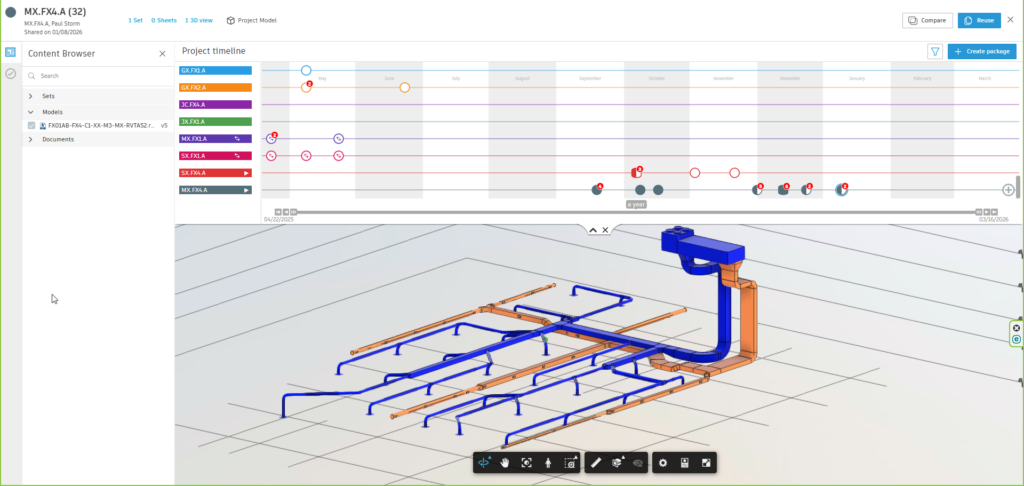
This structured approach ensures that all stakeholders are aligned against a consistent dataset, while maintaining appropriate segregation of responsibilities and authoring control.
From a governance perspective, overarching administrative control of the CDE resides with designated Project Administrators. These individuals are responsible for:
- Managing access permissions and role assignments
- Enforcing information management protocols
- Maintaining the integrity of the data environment
Given the criticality of this role, administrators must operate with a high degree of accountability. The inherent audit functionality within the platform ensures that all administrative actions are recorded, thereby providing transparency and traceability across the project lifecycle.
When properly implemented, this framework significantly reduces the risk of working on incorrect or outdated information and provides a robust, defensible mechanism for information control in accordance with best practice (e.g., ISO 19650 principles).
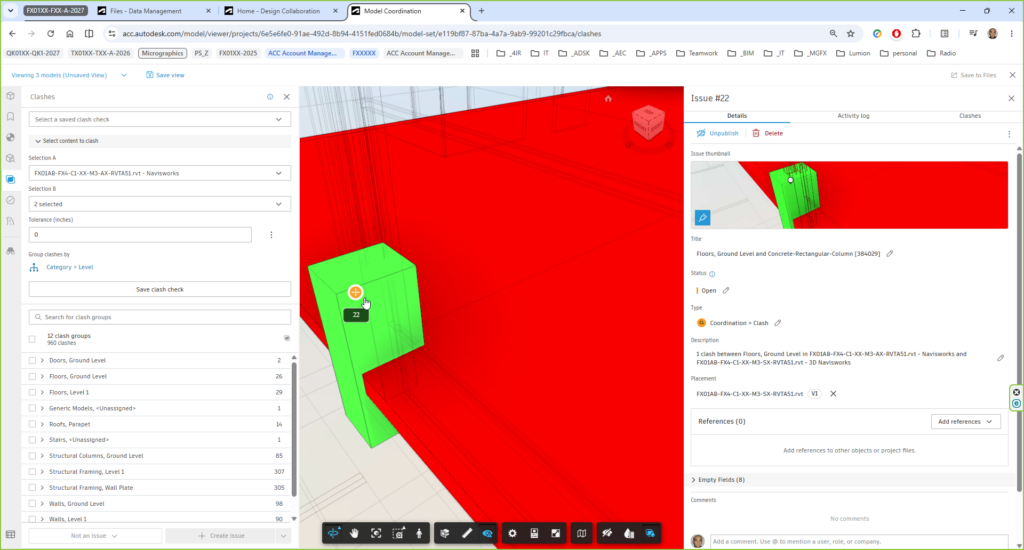
Cloud-based clash detection represents a significant advancement in coordinated design workflows, particularly within the context of Autodesk’s Design Collaboration environment (formerly associated with Autodesk Construction Cloud modules). One of the key recent enhancements is the expansion of supported file formats for clash detection, which now encompasses many distinct file types. This substantially improves interoperability across heterogeneous design authoring platforms.
While a Revit-centric workflow remains the preferred standard for multidisciplinary BIM coordination—due to its native parametric capabilities and data consistency—many projects necessitate the integration of models generated from multiple, disparate authoring tools. In such scenarios, the ability of the platform to support clash detection across varied file formats becomes a critical decision factor.
Consequently, the selection between cloud-based clash detection workflows and traditional desktop-based coordination tools (such as Navisworks) should be informed by:
- The diversity of model authoring platforms in use
- The supported file types for federated model coordination
- The required level of integration within the Common Data Environment (CDE)
Where supported formats align with project requirements, cloud-based clash detection provides advantages in terms of accessibility, version control, and real-time collaboration. However, limitations in file compatibility may necessitate the continued use of Navisworks for coordination.
A further technical consideration is the requirement for time-based (4D) clash detection and simulation, which remains a capability associated with Navisworks. Projects requiring schedule-driven coordination, construction sequencing validation, or temporal clash analysis must therefore incorporate Navisworks into the coordination workflow to address these requirements.
Subscription strategy should be proportionally aligned with the scale, complexity, and delivery requirements of the project. While certain efficiencies and cost optimisations may be achieved through selective subscription allocation, these must be carefully balanced against functional requirements, collaboration demands, and information management objectives.
For large, multidisciplinary Revit-based projects—where multiple design disciplines are concurrently authoring, coordinating, and exchanging BIM data within a Common Data Environment (CDE)—a baseline configuration of subscriptions is recommended to ensure adequate capability across all participants.
The following outlines the minimum recommended subscription framework required to support a large-scale, multidisciplinary Revit project, ensuring:
- Robust design authoring and coordination across disciplines
- Controlled information exchange and version management
- Effective clash detection, review, and design validation workflows
- Alignment with structured BIM processes and ISO 19650-informed information management practices
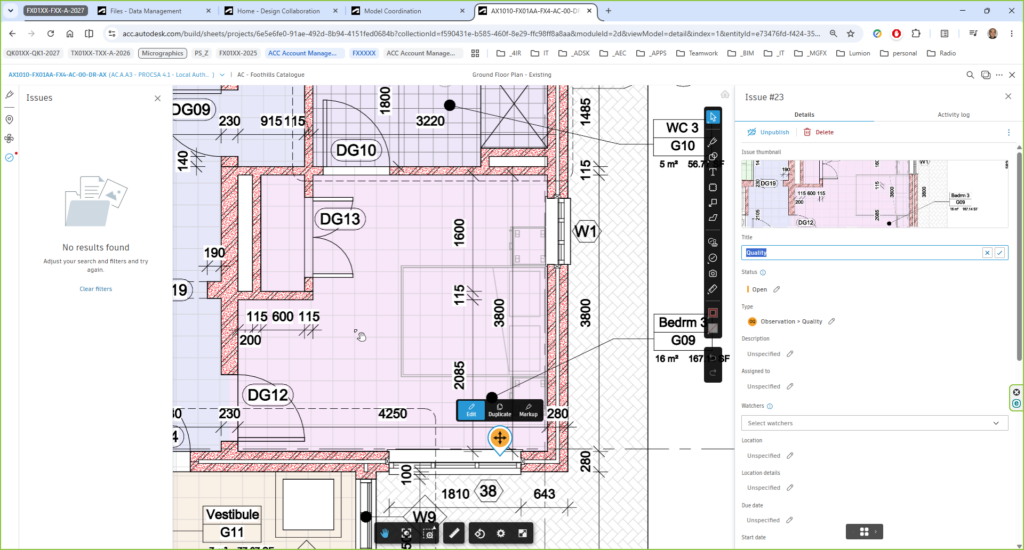
For structured communication workflows between site operations and the design authoring environment—including the management of Requests for Information (RFIs), issue tracking, and field-based data exchange—it is recommended that the minimum platform requirement includes an Autodesk Build subscription.
Autodesk Build provides the necessary functionality to support:
- Centralised RFI management and tracking
- Issue creation, assignment, and lifecycle management across project stakeholders
- Seamless integration between field data capture and the Common Data Environment (CDE)
- Traceable communication workflows linking design intent with construction execution
Accordingly, the deployment of Autodesk Build at a minimum tier ensures that communication between the field and the design office is effectively governed, auditable, and aligned with structured project information management practices.
The adoption of an Autodesk Build (Autodesk Forma Build) subscription provides access to the Cost Management module, a purpose-built capability for centralised financial control within a Common Data Environment (CDE).
This module enables project teams to:
- Establish and manage project budgets, contracts, and cost items within a unified platform
- Continuously monitor cost performance against baseline and committed values
- Perform dynamic cost forecasting, incorporating both planned and actual expenditures
- Identify and quantify cost-related risks in real time, supporting proactive mitigation strategies
Furthermore, the integrated forecasting functionality allows for:
- Time-based cash flow analysis and projection
- Ongoing evaluation of budget performance versus actuals
- Improved predictability of project financial outcomes, including profitability and cost variance
By consolidating cost data and workflows within a single system, the Cost Management module enhances transparency, reduces reliance on disconnected tools (e.g., spreadsheets), and supports data-driven decision-making throughout the project lifecycle.
If you are a Client Consultant
- Design Phase: Forma Design Collaboration
- Build Phase: Forma Build
If you are a Principal Agent
- Design Phase: Forma Design Collaboration
- Build Phase: Forma Build
If you are a Consultant (Designer)
- Design Phase: Forma Design Collaboration
- Build Phase: Forma Build
If you are a Project Manager
- Build Phase: Forma Build
If you are a Contractor
- Build Phase: Forma Build
If you need help adopting the AEC Collection or Autodesk Forma in your practice or you are looking to invest in hardware, please contact Micrographics so that we may be of assistance.

