
Autodesk Construction Cloud (ACC) has been rebranded as Autodesk Forma.
Autodesk has undertaken a strategic consolidation of its cloud-based construction and collaboration solutions, whereby Autodesk Construction Cloud (ACC) has been integrated into the Autodesk Forma industry cloud ecosystem. This transition represents a branding and platform unification initiative rather than a functional system replacement, with existing services continuing under aligned Forma-branded offerings.
As part of this evolution, Autodesk has introduced embedded entitlement to Forma Data Management Essentials (FDME), a limited technology offering that of what was formerly known as Autodesk Docs within selected desktop product subscriptions.
This article expounds on the differences between Forma Data Management (FDM) and Forma Data Management Essentials (FDME). Specifically, users holding standalone subscriptions of AutoCAD, Civil 3D, and Revit, or the Product Design and Manufacturing (PDM) Collection, are provisioned with a baseline cloud collaboration capability, enabling connection to a common data environment (CDE) and facilitating model and document coordination within the Forma ecosystem.
From a storage perspective, the platform is architected to support scalable cloud data hosting, with no explicitly defined limit on overall project storage capacity, while individual file constraints (e.g., maximum file size) apply at a system level.
The following file formats are supported for viewing and collaboration within Autodesk Forma Data Management Essentials on the web.
The illustration below provides a representative screenshot of the web-based user interface within Autodesk Forma Data Management, demonstrating the functional differentiation between Forma Data Management Essentials and the full Forma Data Management offering.
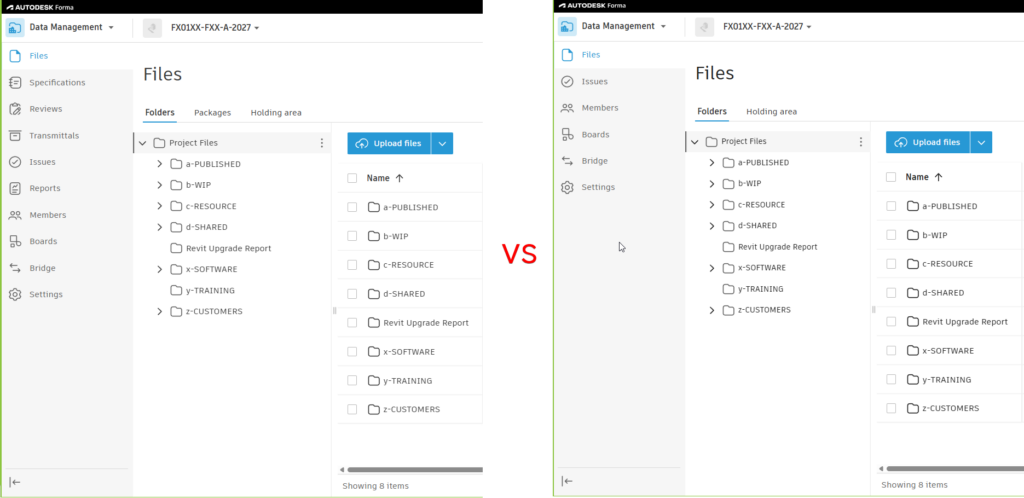
In this comparison, the Essentials-tier environment (right) is characterised by a constrained feature set, limited to foundational capabilities such as file storage, viewing, markups, version control, and basic issue tracking. In contrast, the full Forma Data Management environment (left) exposes an extended functionality set, including advanced capabilities such as workflow automation, document approvals, enhanced permissions governance, and project-level data insights.
This side-by-side interface view highlights the progressive capability reduction from a more comprehensive, enterprise-grade project information management solution to an entry-level common data environment.
The inclusion of Forma Data Management Essentials entitlement within a standalone Autodesk subscription significantly enhances the product’s value proposition by enabling access to a cloud-based common data environment (CDE) hosted within a user-configured Forma Hub. This environment supports centralized storage, organization, and controlled distribution of project information, facilitating collaborative workflows across multidisciplinary teams.
The functional capability of a Forma Hub is governed by the licence entitlements assigned to users and the contractual service tier under which the hub was provisioned, which collectively determine the accessible feature set and level of administrative control within the environment.
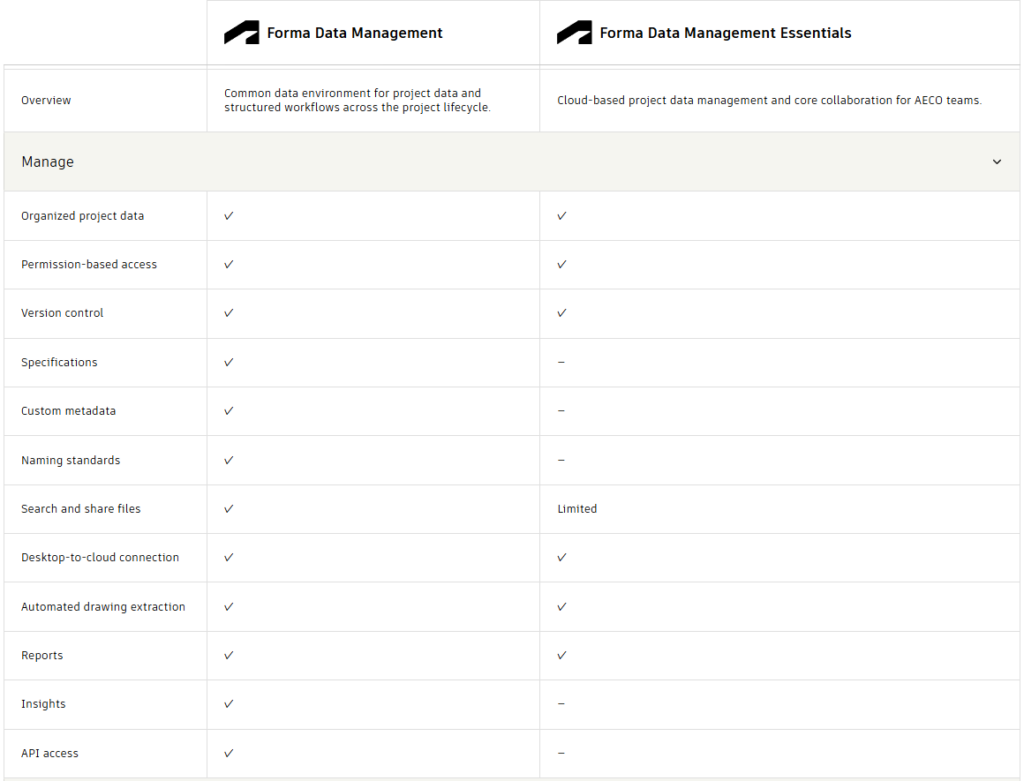
The following observations relate specifically to a hub instantiated under a Forma Data Management Essentials (FDME) entitlement. From a data management perspective, FDME provides foundational common data environment (CDE) capabilities, including the organisation and structuring of project information and the assignment of permission-based access controls. However, this control framework is constrained by a reduced role-definition capability, which may limit the granularity of responsibility segregation and could adversely affect formal project governance and information management workflows.
FDME supports basic version control mechanisms, including the ability to track revisions, compare file versions, and revert to prior states, thereby maintaining continuity and traceability of information containers. However, more advanced configuration capabilities—such as the establishment of custom metadata schemas, specification management, and enforced naming standards—are not available within this entitlement.
In addition, search and information retrieval functionality, as well as controlled file distribution mechanisms, are comparatively limited relative to the full Forma Data Management offering. Integration via Autodesk Desktop Connector enables local synchronisation between the cloud-hosted CDE and the user’s file system, facilitating file access and interaction within native authoring environments.
Despite references to reporting functionality in comparative materials, native reporting interfaces and capabilities are not exposed within the FDME user interface. Furthermore, access to advanced platform features—including Insights (data analytics), extended reporting frameworks, and Autodesk Platform Services (APS) APIs—is not provisioned within the Essentials tier, thereby restricting extensibility, automation, and advanced data interrogation within the hub.
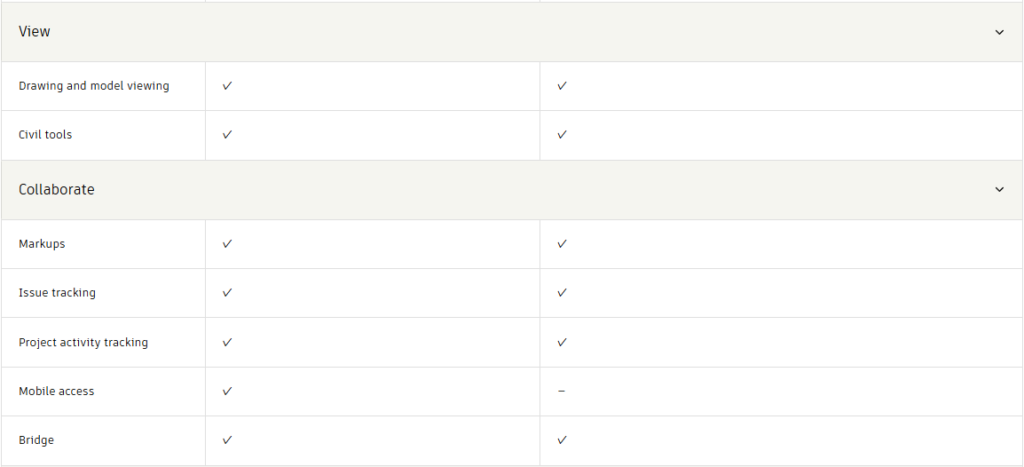
From a viewing capability perspective, the platform supports the interrogation of both 2D and 3D design data, enabling users to access and review a range of model types directly within the web-based viewer. This includes the ability to visualise Civil 3D design models and other supported data sets in both planar (2D) and spatial (3D) contexts, with dynamic switching between view states where applicable.
Additionally, the viewer environment can support complex data representations—such as point cloud datasets and infrastructure models—facilitating model interrogation and coordination activities without requiring access to the native authoring applications.
The platform provides robust collaboration and coordination capabilities, enabling users to perform model and document markups, generate and manage issues, and assign them to designated stakeholders for resolution, thereby supporting structured communication and accountability throughout the project lifecycle.
In addition, the Bridge functionality facilitates controlled data exchange between projects or hubs, allowing users to selectively replicate and distribute project information across different environments while maintaining data ownership and governance
Collectively, these capabilities demonstrate that Forma Data Management Essentials (FDME) is architected to support multi-disciplinary collaboration, particularly for design-centric workflows, providing a common data environment in which designers, project team members, and external consultants can efficiently communicate, review, and coordinate project information.
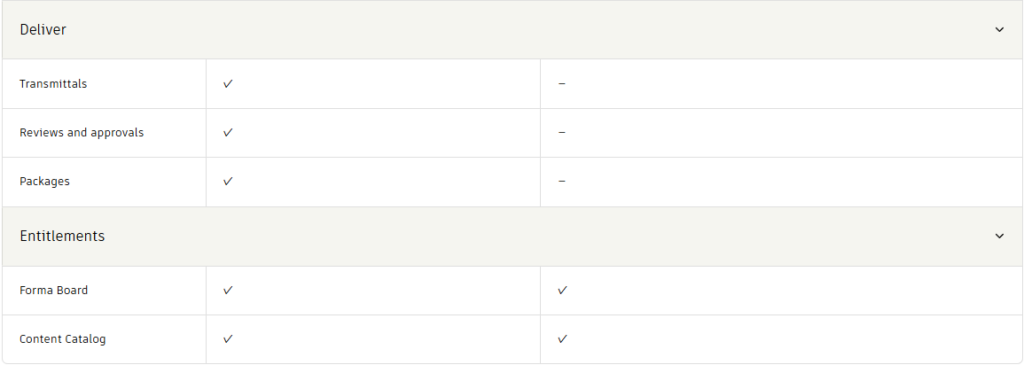
From an information exchange perspective—referred to by Autodesk as information delivery—the Forma Data Management Essentials (FDME) entitlement provides only limited structured functionality. Specifically, the platform does not support key controlled delivery mechanisms such as transmittals, formal review workflows, approval processes, or the creation of structured information packages.
As a result, formalised information management and exchange must be executed through manual processes, including the replication, relocation, and controlled distribution of files in accordance with project-specific protocols. This approach reduces the level of automation, traceability, and governance typically associated with more advanced data management environments.
In this context, supplementary tools—such as Autodesk Design Review or similar markup-based validation workflows—may be required to compensate for the absence of native review and approval functionality, particularly where formal verification, commenting, or design validation processes are required prior to information progression within the project lifecycle.
From an entitlement perspective, users are provisioned with access to a set of supporting platform services within the Autodesk Forma ecosystem, which extend functionality beyond core data management.
These include the Content Catalog, a cloud-based digital asset management repository that enables the centralized storage, versioning, and distribution of BIM content—such as Revit families and CAD objects—thereby ensuring that all project participants access a consistent and approved content library aligned to a single source of truth.
Users are also provided with access to the Autodesk Parameters Service, which facilitates the creation, management, and governance of shared parameters within a centralized cloud environment. This service enables consistent parameter definitions, including associated metadata and identifiers, across projects and authoring tools, thereby supporting data standardisation and interoperability.
In addition, Forma Board is available as a collaborative, BIM-connected visual workspace that supports multi-user engagement in design review and ideation activities. Within this environment, teams can aggregate project data, apply contextual markups, and generate AI-assisted visualisations and renderings, enabling rapid exploration and communication of design intent throughout early-stage and iterative workflows.
A review of the cost–benefit profile clearly demonstrates that the inclusion of Forma Data Management Essentials (FDME) within standard Autodesk desktop subscriptions represents a significant enhancement to the overall value proposition.
From a data management perspective, the platform provides access to a cloud-based common data environment (CDE) with no explicitly defined limitations on total storage capacity, subject to individual file constraints, thereby enabling scalable and persistent management of project information across the lifecycle.
In addition to this scalable storage capability, users gain access to a suite of core collaboration and information management functionalities, including centralized document control, browser-based model and drawing viewing, markups, issue tracking, version management, and controlled sharing mechanisms.
Collectively, these capabilities deliver a substantial value uplift by extending traditional desktop-based design workflows into a connected, cloud-enabled collaboration environment, thereby improving information accessibility, coordination efficiency, and overall project data management maturity within the Autodesk Forma ecosystem.
If you need help adopting the AEC Collection or Autodesk Forma in your practice or you are looking to invest in hardware, please contact Micrographics so that we may be of assistance.

