Before we dive into the Key differences between Fusion Operations and Fusion Management, we need to understand what each software is and what it provides.
What is Fusion Operation?
Fusion Operations is a Production Management and production floor tracking software.
This is a MES system (Manufacturing Execution System) that has been created to track the production system.
Fusion operations was designed to digitize the production process across the shopfloor to assist businesses in improving efficiency and manufacturing Processes throughout.
Fusion Operations is a multi-capable tool used by operations managers, production managers, schedulers, packaging specialists, fulfilment operators, QA teams, and shop floor fabricators. A Manufacturing Execution System, or MES, can monitor, track, report, and even control the various processes and systems used to manufacture goods, from raw material to shipping

Focus Area of Fusion Operations
The focus of Fusion Operations is to empower manufacturers and fabricators with tools to:
- Manage the entire production floor from start to finish.
- Gain visibility into workflows and production performance.
- Identify and reduce waste in processes and resources.
- Predict and plan maintenance to minimize downtime.
- Optimize workforce performance with actionable insights.

Popular Autodesk PLM Solutions: Fusion Manage
Autodesk rebranded Fusion 360 Manage with Upchain to Autodesk Fusion Manage. Upchain now functions as the cloud-based data management component within Fusion Manage, continuing to be “entitled” with that product
Autodesk Fusion Manage is a cloud-based Product Lifecycle Management (PLM) solution that connects people, processes, and data across the entire product lifecycle. It streamlines workflows, enhances collaboration, and provides real-time visibility into product development.

Autodesk PLM can help you minimize the confusion and connect teams with centralized data and process management.
By centralizing workflows and giving stakeholders access to the most up to date information when and where it’s needed you can cut out the clutter and help your team collaborate better across internal departments as well as with external stakeholders

Fusion Operation vs Fusion Manage
| Fusion Operations (MES) | Fusion Manage (PLM) |
| Focuses on production floor execution | Focuses on product lifecycle management |
| Manages day-to-day manufacturing activities | Manages processes like NPI, change control, quality, and suppliers |
| Tracks production flow, machine use, and workforce performance | Connects teams across engineering, supply chain, and operations |
| Helps reduce waste and predict maintenance | Ensures controlled product launches and improvements |
| Boosts efficiency and employee performance | Enhances collaboration and visibility across the enterprise |
MES (Manufacturing Execution System) vs PLM (Product Lifecycle Management)
| MES | PLM |
| Focuses on manufacturing execution | Focuses on managing the product lifecycle |
| Operates on the shop floor | Operates across the enterprise |
| Tracks production activities in real time (machines, operators, workflows) | Manages product data, designs, changes, quality, and suppliers |
| Goal: Optimize production efficiency, reduce waste, and ensure product quality | Goal: Bring products to market faster, with fewer errors and better collaboration |
| Answers: “How do we make the product?” | Answers: “What is the product, and how does it evolve?” |
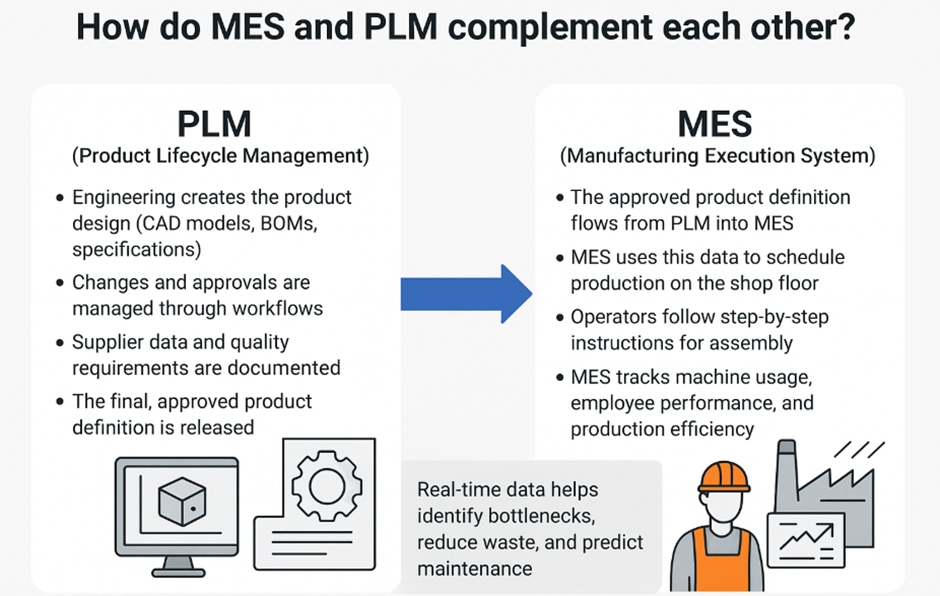
How do MES and PLM complement each other?
In PLM (Product Lifecycle Management)
- Engineering creates the product design (CAD models, BOMs, specifications).
- Changes and approvals are managed through workflows
- Supplier data and quality requirements are documented.
- The final, approved product definition is released.
In MES (Manufacturing Execution System)
- The approved product definition flows from PLM into MES.
- MES uses this data to schedule production on the shop floor.
- Operators follow step-by-step instructions for assembly.
- MES tracks machine usage, employee performance, and production efficiency.
Real-time data helps identify bottlenecks, reduce waste, and predict maintenance
Combined Power of PLM and MES
Seamless Data Flow – Product designs and changes from PLM feed directly into MES, ensuring the shop floor always has the latest information.
Faster Time-to-Market – Engineering defines what to build (PLM) and manufacturing executes how to build it (MES), reducing delays.
Improved Quality – Feedback from MES on production issues flows back into PLM for continuous improvement.
Efficiency & Cost Savings – Less rework, reduced waste, and optimized resource use.
Full Visibility – End-to-end traceability, from product concept (PLM) to finished goods leaving the shop floor (MES).
👉 Together, PLM + MES connect design, planning, and execution—turning innovation into efficient production.

Fusion Operations (MES) and Fusion Manage (PLM) serve different but complementary roles.
PLM manages product data, designs, changes, quality, and supplier processes across the product lifecycle.
MES manages execution on the shop floor, tracking machines, workflows, and workforce performance.
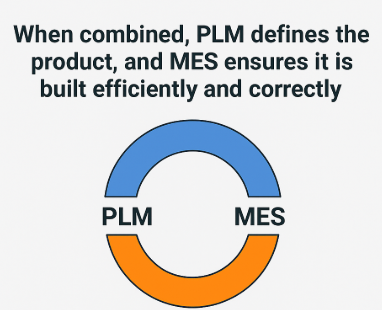
When combined, PLM defines the product, and MES ensures it is built efficiently and correctly. Together, they create seamless data flow, reduce waste, improve quality, shorten time-to-market, and provide full visibility from product concept to finished goods. By connecting PLM and MES, organizations bridge the gap between product innovation and manufacturing execution. This powerful integration ensures that the right products are designed, built efficiently, and delivered to market faster—with higher quality and lower costs. Together, they transform ideas into reality, driving competitiveness and sustainable growth.